
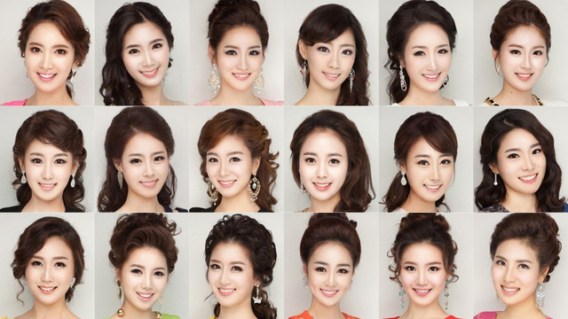
THE MISS KOREA BEAUTY PAGEANT CONTESTANTS, 2013
Sparking contentious debates concerning varying notions of standardized “beauty ideals,” the 2013 Miss Korea Beauty Pageant sheds a particular light on Korea’s unique plastic surgery industry. Scrutinized for representing extremely homogeneous ideals of Korean beauty aesthetics, the similarity of contestants’ physical features were presumed to be the result of technologically assisted “racialized” or “ethnic” cosmetic surgeries.
Yet of greater interest than whether participants underwent such procedures or not, is the implementation of an overt judging, classifying, as well as a hierarchical re-categorizing of what it means to be “beautiful.” It is these imagined notions of “ideal beauty” on both local and global scales that work to forge or dissolve unrealistic conceptions of “the body.” Therefore further insight into this phenomenon is attained via participant’s understandings and feelings around issues of biotechnology, racial or ethnic hybridity, potential attempts to look more “western” or “white” or on the contrary, the thwarting of westerncentrism and the promulgation of an Asian ascendancy.
Set against this backdrop of uniquely complex rapid politico-economic growth, South Korea’s cosmetic surgery industry is telling of much more than beauty ideals. Indeed the country’s adoption of neoliberal policies in the 1980’s overshadowed the remnants of traditional Neo-Confucianism, and a byproduct of this socioeconomic shift can be seen through the example of transitioning gender roles and women’s rights. Discussions ranging from a woman’s place in the workforce to that of fair wages, contraception, marriage and birthrates, and a life outside the private and domestic sphere, have come to the fore. Along with this, issues relating to race, ethnicity and nationalism, as well as gender, age, socioeconomic status, mobility and religion, are increasingly being addressed–as they are seen as inexorably entwined with South Korea’s prodigious, quickly growing and highly globalized cosmetic surgery industry.
Through methods such as critical discourse and visual analysis, varying narratives and dominant tropes that work to conceive, reproduce, and propagate unattainable “ideals” of beauty—continue to be analytically deconstructed and critically assessed as this body of literature on globalized beauty and biotechnology progressively expands.
_________________________________________________

Born and raised in California’s San Francisco Bay Area, I graduated with a B.A. in Anthropology from the University of California, Berkeley, where I conducted critical research on discourses around beauty through case studies of ethnic/racialized cosmetic surgeries among Asian and Asian-Americans.
As an undergraduate student, I also attended the University of Cape Town, South Africa, focusing on Cultural Anthropology and African Studies. Several months of post-semester traveling throughout South and Eastern Africa informed and inspired much of my past research on environmental anthropology, political ecology, ecotourism and “sustainable travel” in regions of East Africa, as well as studies in Multispecies Ethnography. Yet while my research interests are still grounded in Critical Tourism studies, my most current work examines the world of ethnic/racialized cosmetic surgeries within East Asia’s medical tourism industry. And as an epicenter for medical tourism and aesthetic plastic surgery around the globe, the main site for my fieldwork is geographically situated in the center of Gangnam-Gu Seoul, South Korea.
_________________________________________________
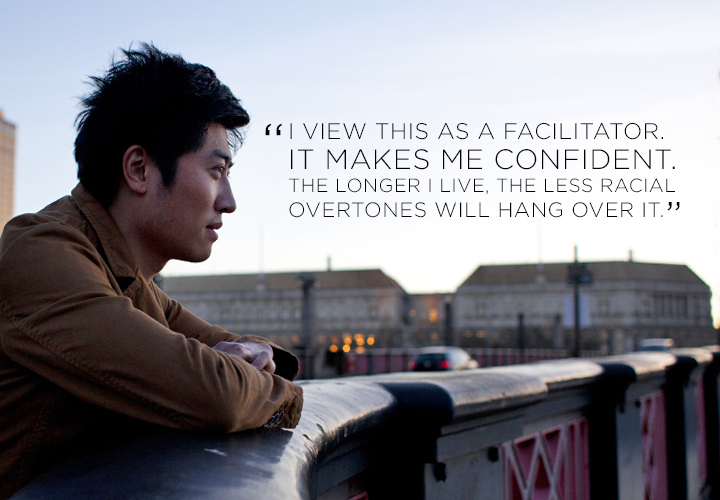 “This cosmetic surgery is a way to gain equality”
– Leo Jiang, Chinese patient who has undergone an array of racilaized plastic surgeries
By approaching this topic from a critical feminist, postcolonial, and medical anthropological perspective, this work contributes to current literature by expanding on notions of racial malleability, biotechnology, the co-opting of racial and ethnic identities, and the allure of “cosmopolitan whiteness” vis-à-vis various corporeal beauty practices. From double eyelid surgery to facial bone contouring, skin bleaching to interpretations of normalized bodies, my work provides an ethnographically grounded analysis of this rapidly expanding industry, including the globalized market trade of these “health” services across borders.
______________________________________________
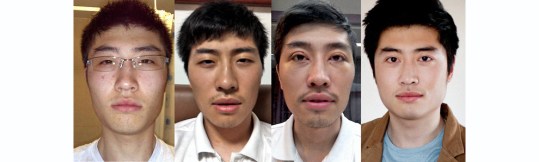 Leo Jiang, Before, During, and After his Cosmetic Surgeries
______________________________________________
Thus through critical analysis of this prolonged ethnographic fieldwork, this study contributes to, and expands upon conceptions around the standardization of beauty and racialized cosmetic surgeries among East Asians. Furthermore, I focus on if and how these elective procedures pertain to practices of “modernity,” imbricated within “the body” as well as the political economy. And I do so while striving to situate this project within the contexts and confluences of race, gender, ethnicity, age, and class. Lastly, while factoring in these variables through an intersectional approach, I work to incorporate the possible implications of such surgeries in respect to issues of power, mobility, shifting gender roles, and the ways in which “the body” is perceived, be it as “natural”, as a malleable asset, as something commodifiable, or as a biotechnological means of currency that can alter and enhance one’s socioeconomic status.
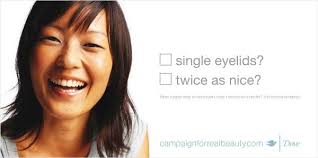 An advert for the “Natural Beauty” Dove Campaign, Taiwan
 Kimiko H. Tanita: Cultural Anthropologist & PhD Candidate